Open the game ▸

Grade 5 Maths Games for Kids Learning Through Play with MathQuest

Practical Year 5 maths, explained simply for parents

Grade 5 is a year of deeper thinking. Children work with more precise decimals, equivalent fractions and early percentages. They also become more independent at choosing a method, estimating an answer and explaining why it makes sense.

MathQuest is designed around short adventures where children use maths to solve problems and keep exploring. This guide explains what your child is learning, why the skills matter and how you can help without turning home into another classroom.

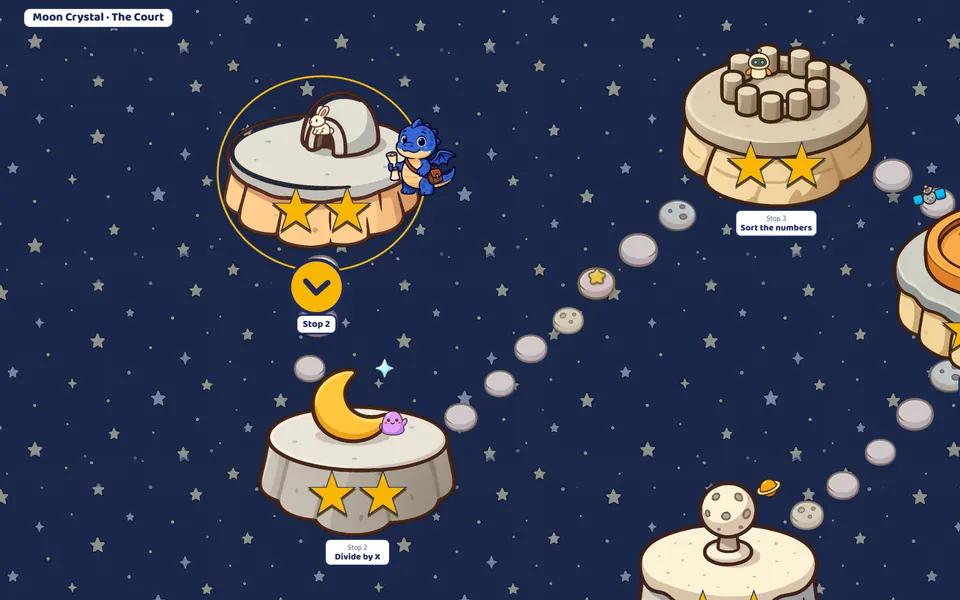
A Year 5 map in MathQuest: islands under a starry night sky joined by a path of moon stones, each island a game, with Daviel the dragon on the first one.

What maths does your child learn in Grade 5?

The Australian Curriculum calls this level Year 5. The six areas below translate its maths content into everyday language. Children work through these ideas over the year, at different speeds. They are not a test you need to give your child at home.

1. Decimals and the value of each digit
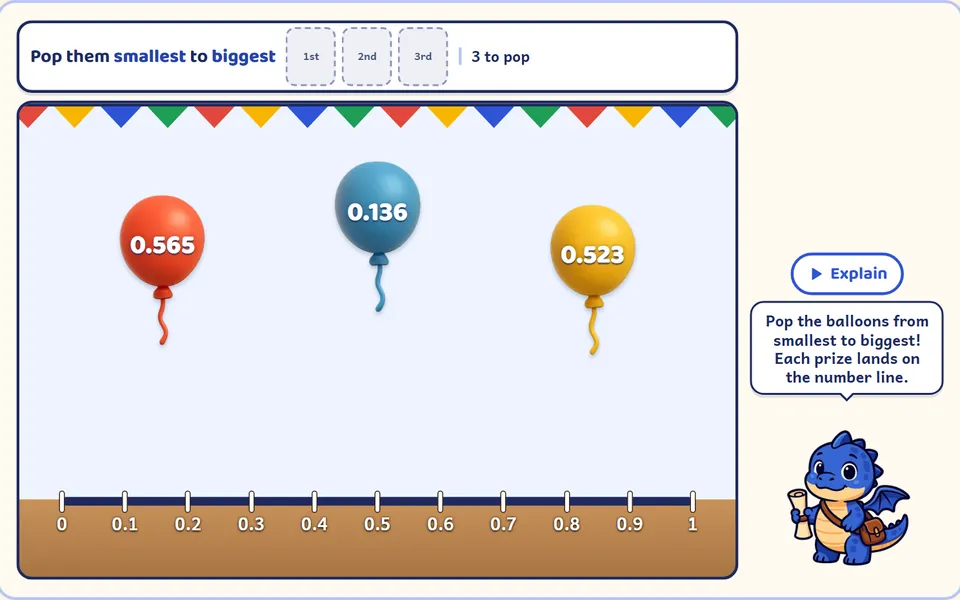
Balloon Pop in MathQuest: balloons numbered 0.565, 0.136 and 0.523 to pop from smallest to biggest, above a number line from 0 to 1.

What is your child learning?

Children interpret, order and compare decimal numbers with more than two decimal places. They learn to look carefully at the position of digits rather than assuming the longest number is the biggest.

For example, 2.35 is bigger than 2.305, even though the second number has more digits after the decimal point. A number line or place-value chart helps make this clear.

How MathQuest helps

Balloon Pop asks children to order decimals with up to three places, where the longest number is not always the biggest. Number-Line Jump has them place decimals on a 0 to 10 line, and Round it rounds decimals.

MathQuest games: Balloon Pop, Number-Line Jump, Round it

Try it at home

Write 2.35, 2.305 and 2.5 on cards. Ask your child to put them in order and explain why, using a number line if helpful.

Australian Curriculum: AC9M5N01
2. Factors, multiplication and division

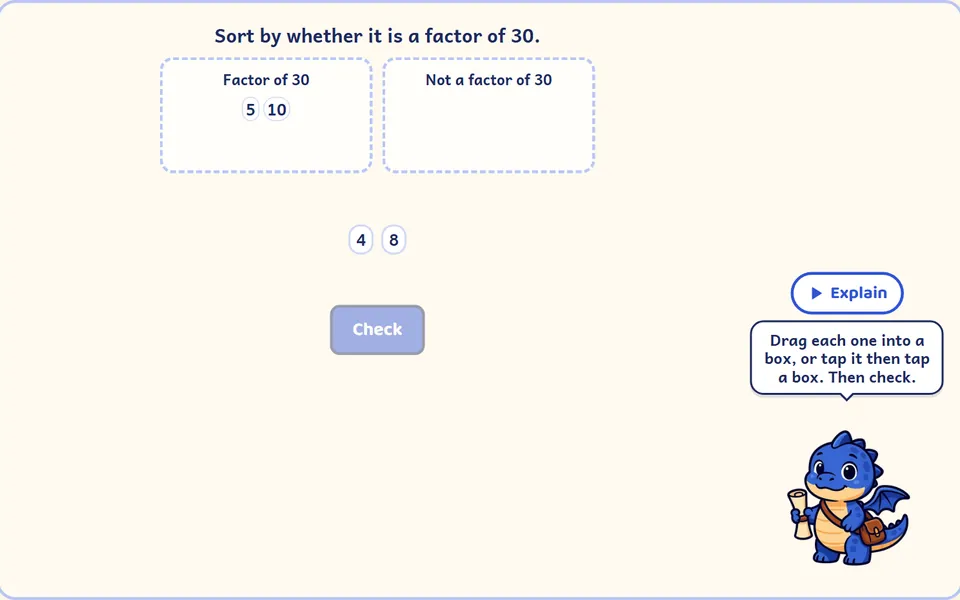
Sort the numbers in MathQuest: 5 and 10 sorted into Factor of 30, with 4 and 8 still to sort into Factor of 30 or Not a factor of 30.

What is your child learning?

Children explore factors and multiples, use efficient methods to multiply larger numbers and divide by single-digit numbers. They also learn what a remainder means in a real situation.

If 25 children need to travel in vehicles holding six people each, the answer is not simply four remainder one. They need five vehicles. Understanding the context helps them interpret the calculation.

How MathQuest helps

Sort the numbers asks children to sort numbers by whether they are factors or multiples, for example which numbers are factors of 30. Long multiplication works through larger multiplications step by step. Divide by X practises the division facts, and Find the missing number asks for the missing number in a multiplication or a division.

MathQuest games: Sort the numbers, Long multiplication, Divide by X, Find the missing number

Try it at home

Arrange 24 buttons into equal rows to find its factors. Try sharing 25 biscuits among six bowls and talk about what the leftover means.

Australian Curriculum: AC9M5N02, AC9M5N06, AC9M5N07

3. Fractions, equivalent values and percentages

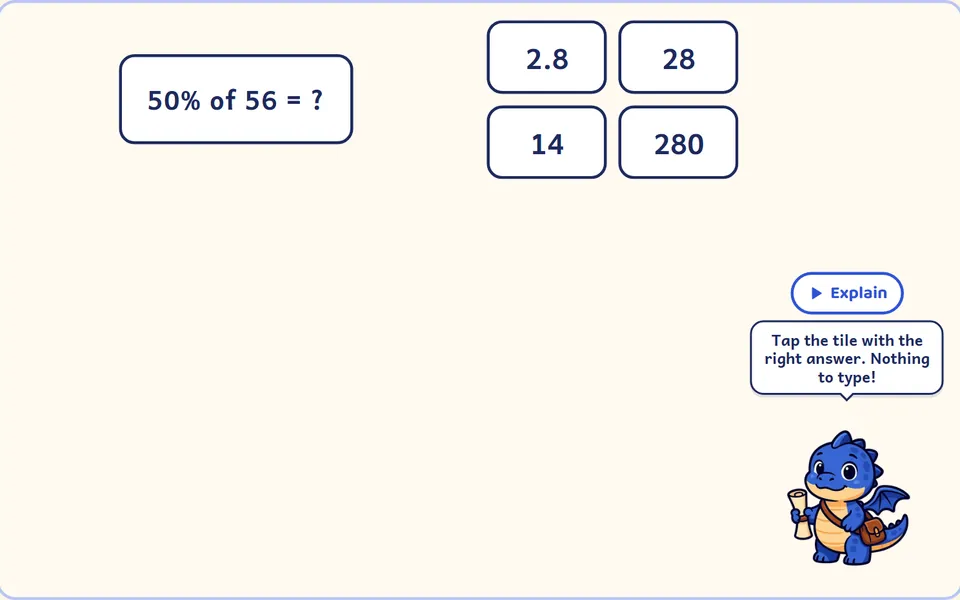
Percent it in MathQuest: "50% of 56 = ?" with four number tiles.

What is your child learning?

Children compare and calculate with fractions that have the same or related denominators. They make connections between common percentages, fractions and decimals, such as 50%, one half and 0.5.

Understanding that these are different ways of describing the same amount is more useful than memorising a list. Children also begin reasoning about sums such as a half plus a quarter.

How MathQuest helps

Fraction Bridge asks children to add fractions such as 4/5 + 1/10. Percent it asks them to find 50%, 25% or 10% of an amount and to place a percentage on a number line.

MathQuest games: Fraction Bridge, Number-Line Jump, Percent it

Try it at home

Fold paper into eighths, shade four parts and ask what fraction and percentage it represents. Use a chocolate bar illustration if that's more engaging.

Australian Curriculum: AC9M5N03, AC9M5N04, AC9M5N05

4. Area, perimeter, angles and measurement

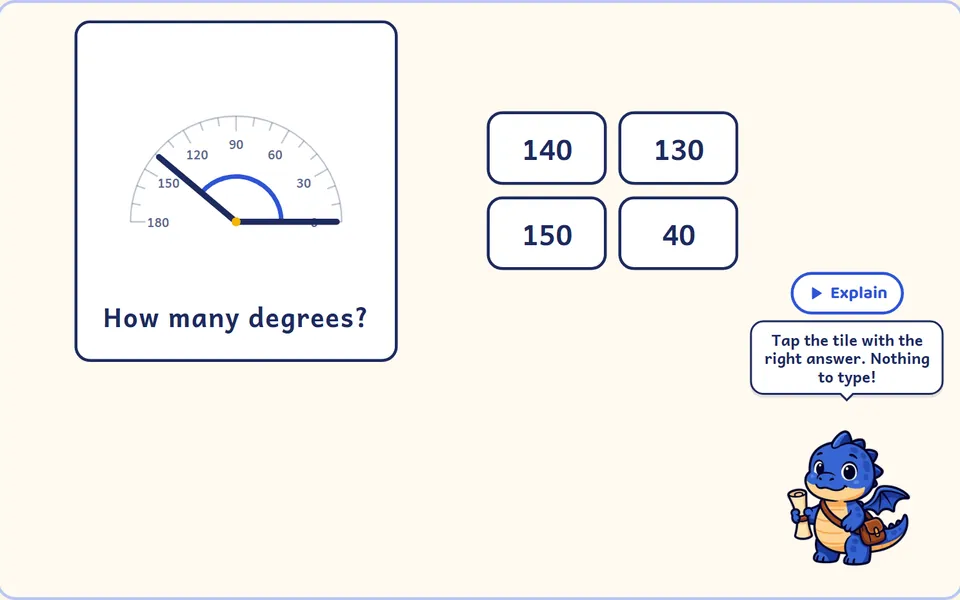
Turns and angles in MathQuest: an angle on a protractor and the question "How many degrees?".

What is your child learning?

Children select sensible metric units, calculate perimeter and area and estimate or construct angles in degrees. They also work with everyday measurements in more precise ways.

Area and perimeter can be confusing because they describe different things about the same shape. Drawing a rectangle on square paper helps children see the distinction.

How MathQuest helps

Geometry asks for the perimeter of a shape on a grid. Turns and angles asks children to read an angle on a protractor. Measure it combines units such as kilograms and grams.

MathQuest games: Geometry, Turns and angles, Measure it

Try it at home

Draw a rectangular garden on grid paper, count the perimeter and area, then change the dimensions while keeping the same area. Talk about what changed.

Australian Curriculum: AC9M5M01, AC9M5M02, AC9M5M04

5. Coordinates, 3D shapes and transformations

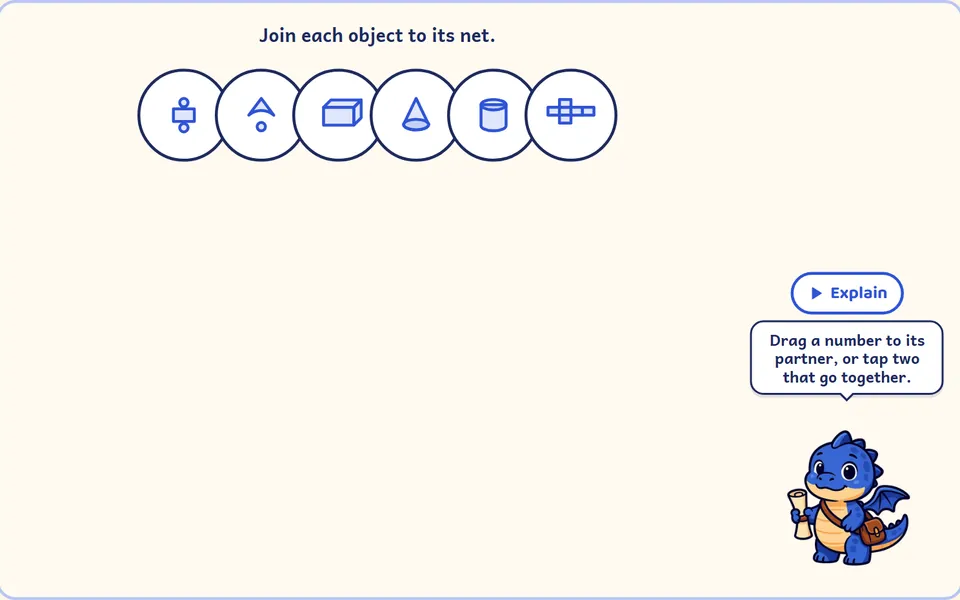
Match the net in MathQuest: a row of 3D objects and their nets, and the task "Join each object to its net".

What is your child learning?

Children use coordinates to locate points on a grid and explore three-dimensional objects and their nets. They learn to describe movements, turns and symmetry.

A drawing of a flattened cube might look nothing like a box at first. Building it helps connect the picture to a real object. Grid positions also become increasingly precise.

How MathQuest helps

Find the spot asks children for the coordinates of a point on a grid. Match the net asks them to match 3D objects to their nets.

MathQuest games: Find the spot, Match the net

Try it at home

Draw a map on grid paper and hide a marker at a coordinate. Fold a simple cube net from paper and test whether it closes correctly.

Australian Curriculum: AC9M5SP01, AC9M5SP02, AC9M5SP03

6. Investigating data and likelihood

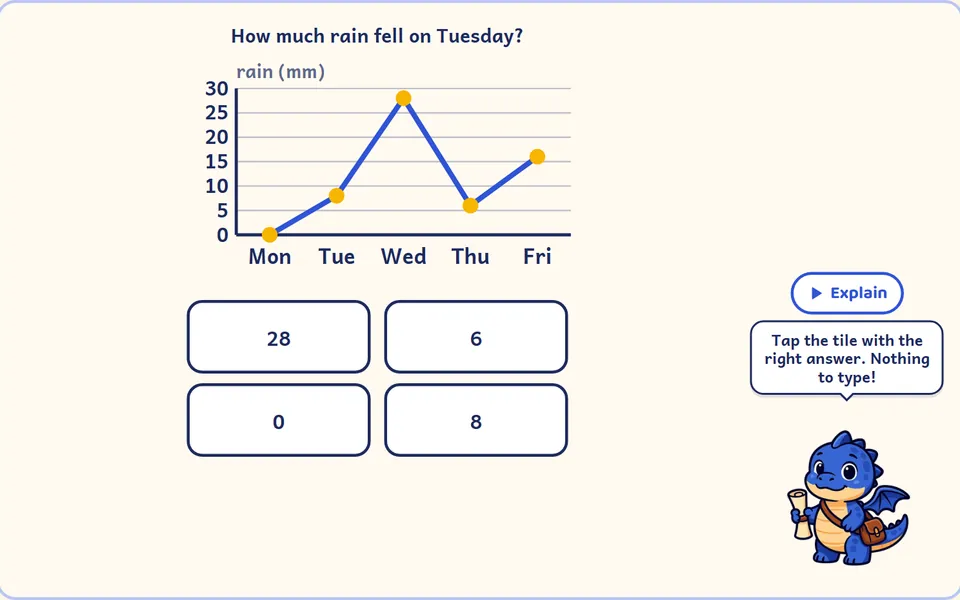
Read the graph in MathQuest: a line graph of rain on each weekday and the question "How much rain fell on Tuesday?".

What is your child learning?

Children collect and analyse information, including data shown in line graphs. They begin looking at trends and variations, and explore chance through experiments and possible outcomes.

When a graph changes across time, it tells a different story from a single total. Children learn to ask whether two sets of data support the same conclusion.

How MathQuest helps

Read the graph asks children to read a line graph and find the mode. Sort the chances asks whether a spinner's outcomes are equally likely, and What are the chances? asks them to list the possible outcomes.

MathQuest games: Read the graph, Sort the chances, What are the chances?

Try it at home

Track daily temperature for a week and draw a line graph. Predict coin-toss outcomes, record twenty tosses and compare what happened.

Australian Curriculum: AC9M5ST01, AC9M5ST02, AC9M5P01, AC9M5P02

Why MathQuest? Maths with a reason to keep exploring

Children are more likely to engage when a problem has a purpose. In MathQuest, each game finished moves your child along the map to the next island, and each map ends with a boss level.

Each game is five questions, usually a minute or two, so it is easy to fit into family life.

Skills come back on later maps, in different games and in each map's boss level, so children keep practising what they have learnt. That repetition is deliberate: understanding is built by practising and recognising a familiar idea. Our aim is for children to want another game because they're enjoying themselves.

Learning continues beyond the screen

Maths in a game should connect with maths in daily life. Talking about prices, following directions, comparing measurements and explaining a calculation are simple ways for parents to reinforce what children explore in MathQuest.

How can you help your Grade 5 child at home?

You don't have to reteach the school day. Choose one ordinary activity and ask your child to explain their thinking. You might say, “How did you work that out?” or “Does that answer seem about right?” Let them use drawings, objects, a number line or another method that makes sense to them.

Keep it relaxed. When children are tired or frustrated, another time may work better. The point is to make the learning feel understandable and useful, not to race through worksheets.

Common questions from parents

What should my child know in Grade 5 maths?

The Year 5 Australian Curriculum includes the number, operations, patterns, measurement, space and data concepts explained above. Children learn these across the school year. Ask your child's teacher which skills are being taught now and what support would be helpful.

Is Grade 5 the same as Year 5?

Yes. In Victoria, families often say Grade 5. The Australian Curriculum calls the same year level Year 5.

What if my child finds a topic difficult?

Start with a smaller number or simpler example. Try drawing the problem or using objects to show what's happening. If difficulty continues or is affecting your child's confidence, their teacher can help identify a suitable next step.

Does my child need to practise maths every day?

There is no single practice length that suits every child. A short, useful activity at a relaxed time can be easier to repeat than a long session. Follow your child's needs and their teacher's guidance.

Does MathQuest replace maths lessons?

No. MathQuest is intended to complement classroom learning and give children another way to practise and apply maths through play.

Let their next maths adventure begin

Whether your child is learning a new number strategy, finding a fraction or reasoning through a measurement problem, every small success is another step forward. MathQuest aims to make those moments part of an enjoyable adventure.

Short games. Real maths skills. A world waiting to be explored.

The first six games are free with a free account. After that, MathQuest is $4.99 a month or $29 a year.