Open the game ▸

Prep Maths Games for Kids Learning Through Play with MathQuest

Fun maths games for children starting school.

Starting school is a big adventure. In Prep, also known as Foundation, children begin discovering how numbers, shapes and patterns work. They learn to count, compare, share and solve little problems that come up every day.

MathQuest is designed to bring that learning into a game. Instead of facing a page of sums, children use maths as part of an adventure, working through short challenges and finding out what happens next.

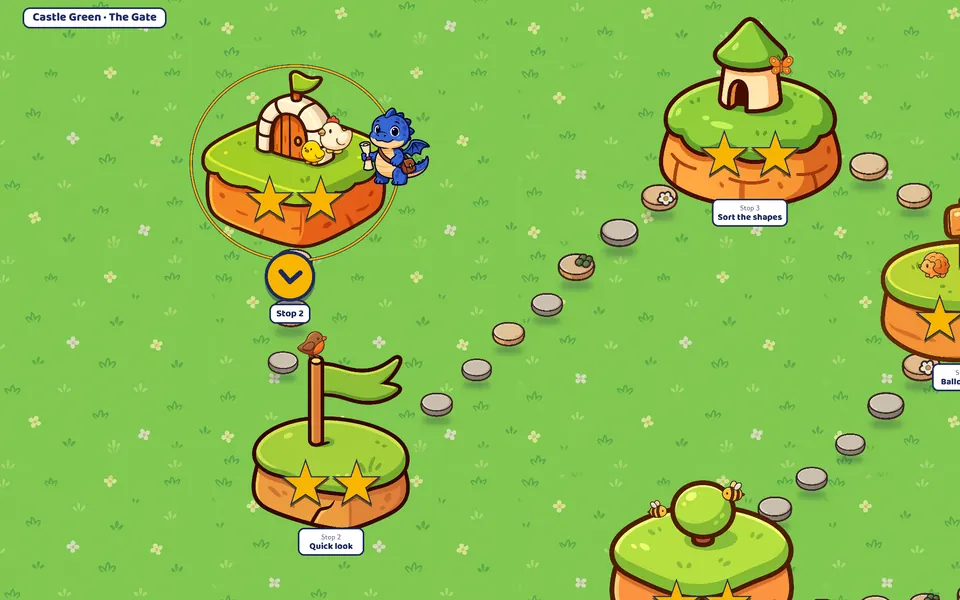
A Prep map in MathQuest: islands joined by a stepping-stone path, each island a game, with Daviel the dragon on the first one.

What maths does your child learn in Prep?

The Australian Curriculum describes the foundations children build during their first year at school. You don't need to know the curriculum or become a maths teacher to help. The six areas below explain what the learning means, which MathQuest games practise it, and what you can try together at home.

1. Counting and understanding numbers
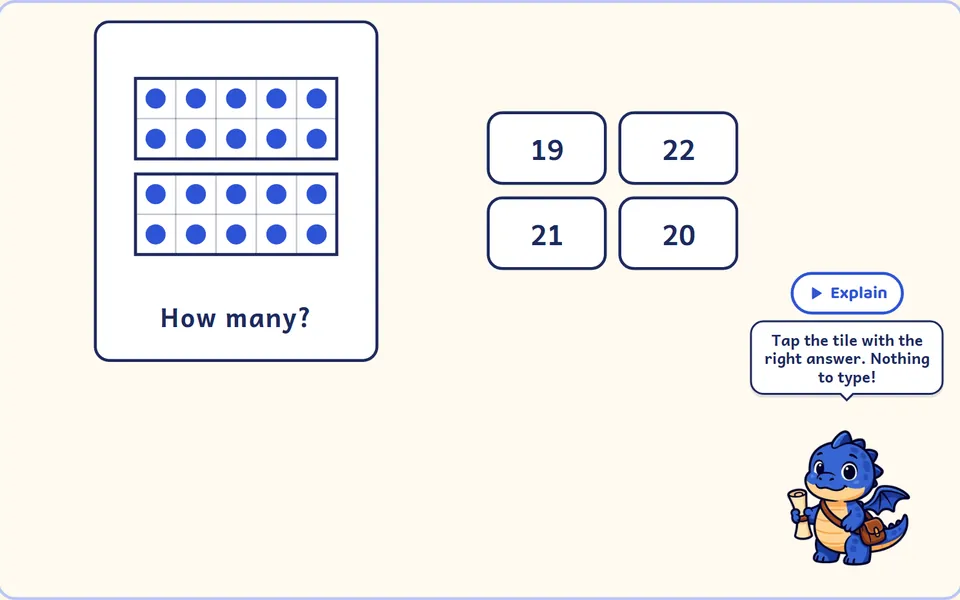
Count them in MathQuest: two ten-frames of dots and the question "How many?", with four number tiles to choose from.

What is your child learning?

One of the first big steps in Prep is understanding that numbers represent amounts. Five means five blocks, five apples or five fingers. Children learn to recognise and order numbers, count forwards and backwards, and connect the number they say to each object they count, working with numbers to at least 20.

It's possible to recite the numbers to 20 but still find it hard to hand someone exactly seven blocks. That difference matters: learning the number words is one step; understanding quantities is another. Children build that understanding through plenty of small experiences.

How MathQuest helps

In Count them, children count dots set out in ten-frames, dice patterns and rows, and pick the number. Lily Pad Leap has them hop along the pads counting up by ones, and Balloon Pop and Order the numbers ask them to put numbers to 20 in order.

MathQuest games: Count them, Lily Pad Leap, Balloon Pop, Order the numbers

Try it at home

Count the steps from the car to school, plates on the table or toys going back into a box. Once your child is comfortable, try: “We've got four plates. How many more do we need for six people?” Keep the question part of whatever you're already doing, rather than turning it into a test.

Australian Curriculum: AC9MFN01, AC9MFN03
2. Recognising small groups and making numbers

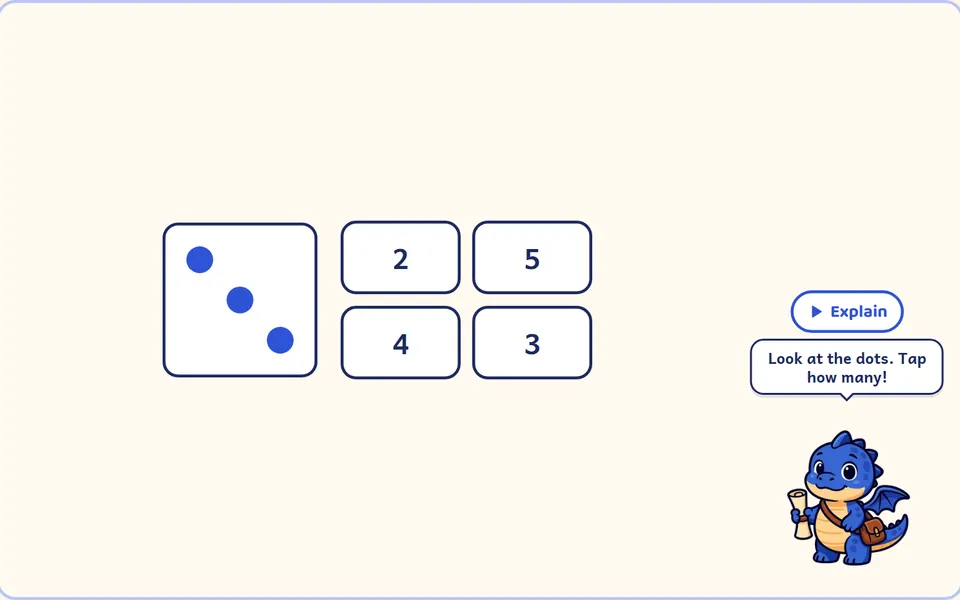
Quick look in MathQuest: a dice face with three dots and four number tiles to choose from.

What is your child learning?

When you see three apples, you probably know there are three without counting them one by one. Children learn this skill with small groups of up to five objects. Teachers call it subitising. They also begin seeing that a number can be made in different ways: five could be two and three, or four and one.

These early number relationships matter because later addition and subtraction make more sense when children already know that amounts can be split and combined.

How MathQuest helps

Quick look shows a dice pattern of one to five dots, then hides it in later levels, so children learn to see a small amount at a glance without counting each dot. Join the bubbles asks them to join two numbers that make 10.

MathQuest games: Quick look, Join the bubbles

Try it at home

Hold up three fingers for a moment and ask how many your child saw. Later, show five as two fingers on one hand and three on the other. You can do the same with buttons, blocks or fruit. Give them time to explain what they noticed.

Australian Curriculum: AC9MFN02, AC9MFN04

3. Adding, taking away and sharing

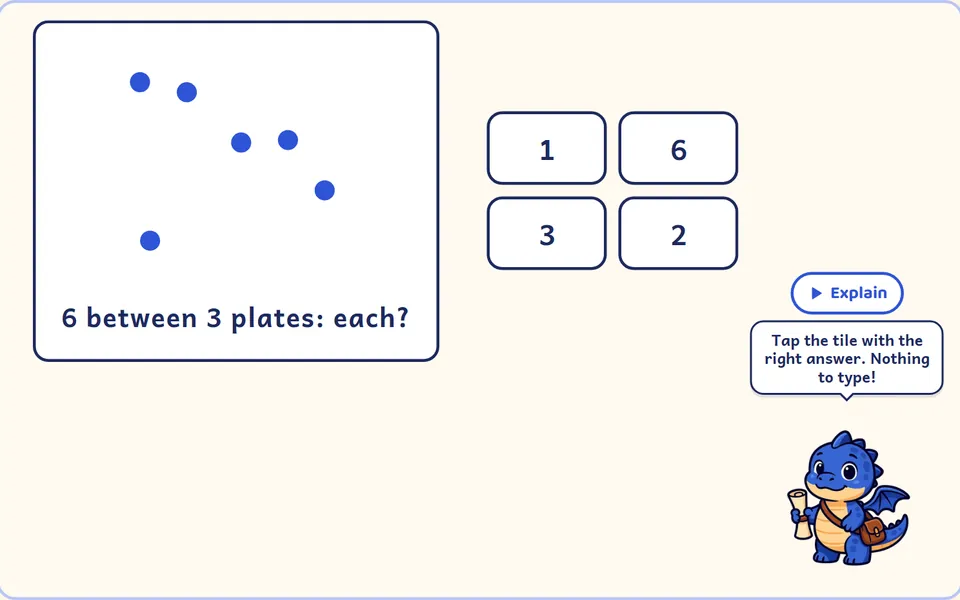
Count them in MathQuest, sharing: six dots and the question "6 between 3 plates: each?".

What is your child learning?

Prep children begin exploring what happens when objects are put together, taken away or shared. Three toy cars plus two more makes five. Six biscuits with two eaten leaves four. Sharing eight blocks between four people gives each person two blocks.

At this stage, physically moving objects and explaining what's happening is often more useful than rushing into written sums. Children are learning to make sense of changes in amount and fair sharing.

How MathQuest helps

Children add small numbers in Adding numbers, find pairs that make 10 in Join the bubbles, and share dots out onto plates in Count them.

MathQuest games: Adding numbers, Join the bubbles, Count them

Try it at home

Use the moments you already have. Ask your child to share six grapes equally, match pairs of socks from the laundry or count how many leaves remain after you take three away. Let them move the objects as they think. The conversation matters as much as the answer.

Australian Curriculum: AC9MFN04, AC9MFN05, AC9MFN06

4. Finding and continuing patterns

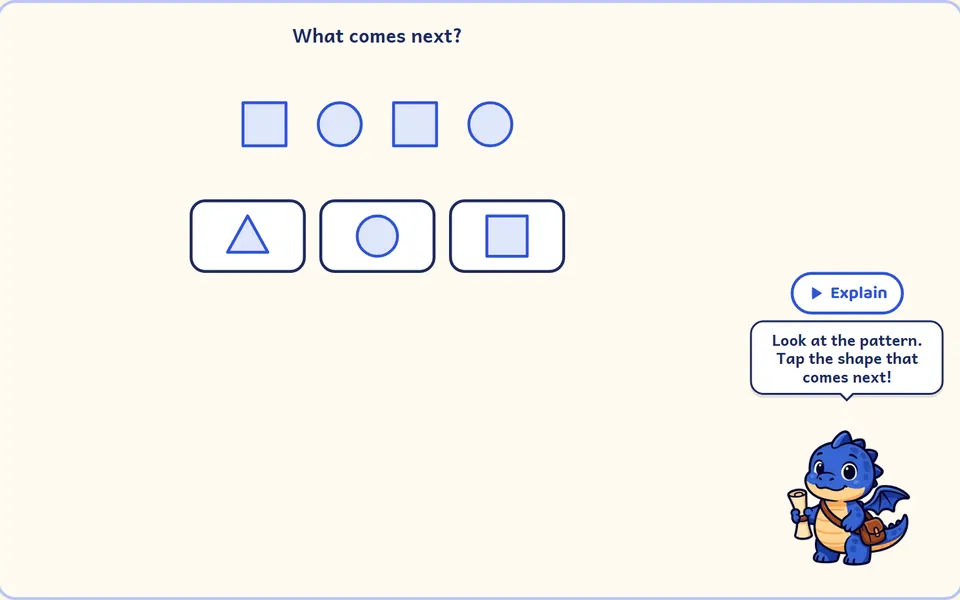
Patterns in MathQuest: a row of squares and circles, and three shapes to choose what comes next.

What is your child learning?

Patterns appear in clothes, floor tiles, music and daily routines. In Prep, children learn to notice something repeating, explain the rule and work out what should come next. It might be red, blue, red, blue, or clap, clap, tap, clap, clap, tap.

Spotting what stays the same and predicting the next step is an early form of mathematical reasoning. Children are learning to look for a rule, not just guess.

How MathQuest helps

In Patterns, children look at a repeating row of shapes and choose what comes next.

MathQuest games: Patterns

Try it at home

Make a spoon, fork, spoon, fork pattern while setting the table. Try coloured blocks or a clapping sequence. Then swap roles and ask your child to create a pattern for you to finish.

Australian Curriculum: AC9MFA01

5. Shapes and where things belong

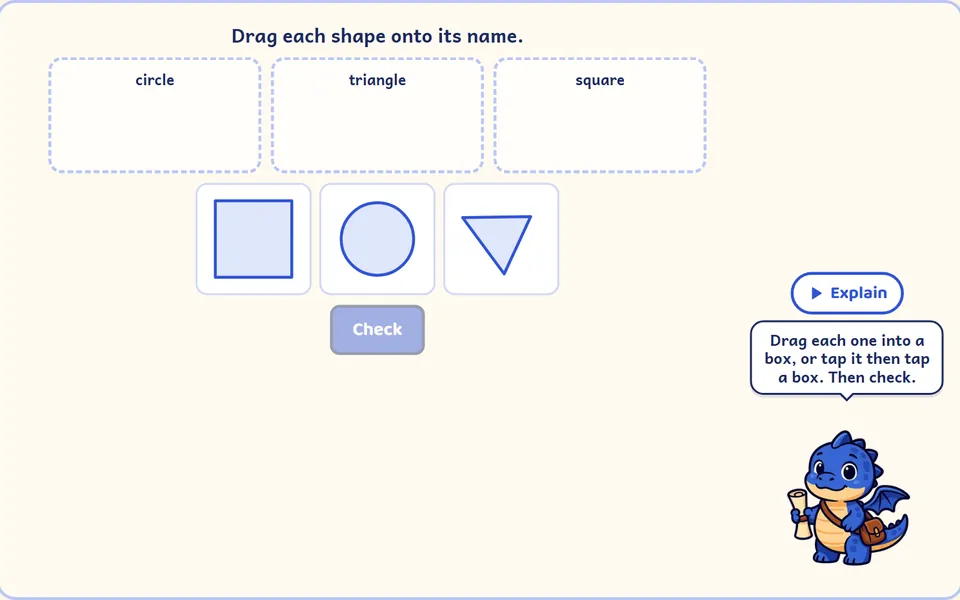
Sort the shapes in MathQuest: a square, a circle and a triangle to drag onto their names.

What is your child learning?

Children recognise and compare familiar shapes, including circles, triangles, squares and rectangles. They begin describing what makes shapes different and learn words that explain where objects are: above, below, beside, behind and between.

This isn't just about naming shapes correctly. It helps children follow instructions, describe their surroundings and understand the position of objects in a space.

How MathQuest helps

In Sort the shapes, children drag circles, triangles and squares onto their names. In Find the spot, they say whether a star is above, below or beside another object.

MathQuest games: Sort the shapes, Find the spot

Try it at home

Go on a shape hunt around the house: “Can you find something with three sides?” Or use toy instructions: “Put the teddy behind the chair and the red block beside the blue one.” Short activities like these help children practise the language in context.

Australian Curriculum: AC9MFSP01, AC9MFSP02

6. Comparing, measuring and sorting

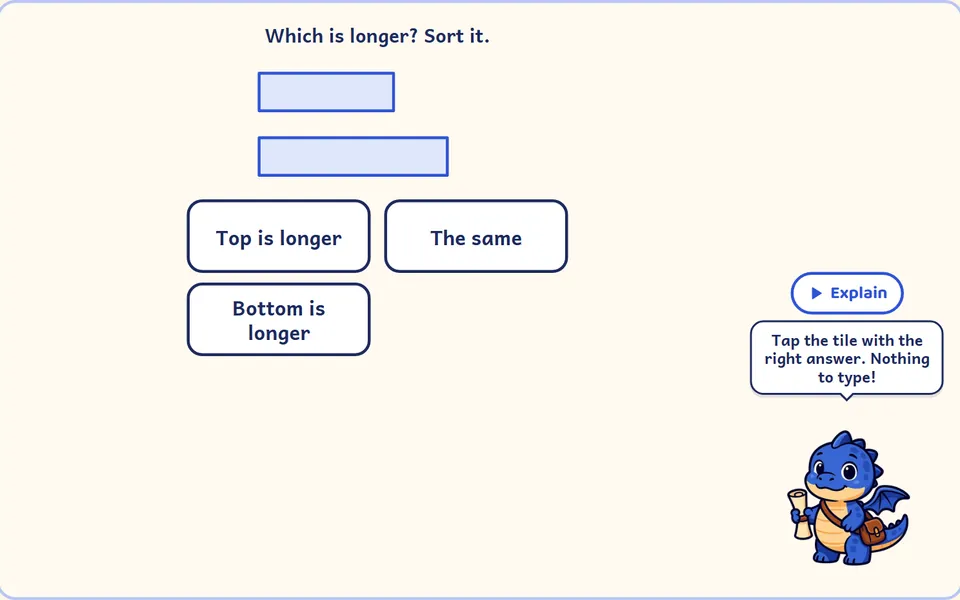
Measure it in MathQuest: two bars and the question "Which is longer?".

What is your child learning?

Children explore the difference between longer and shorter, heavier and lighter, and more and less full. They begin ordering familiar events such as breakfast, lunch and bedtime. They also learn to sort things into groups and talk about which group has more or fewer objects.

These are early ways of measuring and making sense of information. You don't need a ruler or graph to begin: children can compare two sticks, two bags or two collections of toys.

How MathQuest helps

Measure it asks which of two bars is longer. Put time in order asks children to order morning, lunchtime, afternoon and night, and the days of the week, and Count them asks which of two groups has more.

MathQuest games: Measure it, Put time in order, Count them

Try it at home

Sort laundry into pairs, put leaves in order from shortest to longest, compare which bottle might hold more water, or talk about what happens first and next during your day. These conversations build the language children use at school.

Australian Curriculum: AC9MFM01, AC9MFM02, AC9MFST01

Why MathQuest? Because learning should feel like an adventure

Each game is five questions, usually a minute or two. A map has six games and a boss level.

Each game finished moves your child along the map to the next island. Skills come back on later maps, in different games and in each map's boss level, giving children repeated opportunities to practise without each attempt feeling like another worksheet.

Our goal is simple: we want children to choose another game because they're enjoying themselves, not because Mum or Dad has asked them to do more maths.

Maths continues beyond the screen

The game is one part of the picture. Counting objects, sorting washing, sharing food and noticing shapes in the real world all help children connect what they practise with everyday life. MathQuest is intended to complement those moments, not replace them.

How can you help your Prep child with maths at home?

You don't need to run lessons at home. Involve your child in ordinary activities, ask “How did you work that out?” and give them time to think. Count objects in the car, talk about shapes on a walk or share snacks at dinner.

Choose relaxed moments when your child is interested. If they're tired or frustrated, try again another time. Helping them feel comfortable exploring a problem is more valuable than turning every moment into a test.

Common questions from parents

What should my child know in Prep maths?

Throughout Foundation, children build early skills with numbers to at least 20, small groups, adding and taking away, sharing, patterns, shapes, measurement and sorting information. These develop over the school year, not all on day one. Your child's teacher can explain what they're working towards.

Is Prep the same as Foundation?

Yes. In Victoria, the first year of primary school is commonly called Prep. The Australian Curriculum calls the same year level Foundation.

My child is struggling with counting. Should I worry?

Children develop at different rates. Begin with small collections and everyday counting, and focus on making the experience positive rather than racing to a number. If you're concerned or the difficulty continues, talk with your child's teacher for individual advice.

How much maths should my Prep child practise?

There is no need for a long daily lesson. A short, enjoyable activity at a time when your child is relaxed can be a useful starting point. A MathQuest game is five questions, usually a minute or two, so it fits around family life.

Can MathQuest replace school maths lessons?

No. MathQuest is designed to support what children learn at school by giving them another way to practise and apply maths through play.

Let their maths adventure begin

Whether your child is learning to count, recognise a shape or share objects fairly, each small step builds a foundation for what comes next.

Short games. Real maths skills. A world waiting to be explored.

The first six games are free with a free account. After that, MathQuest is $4.99 a month or $29 a year.